

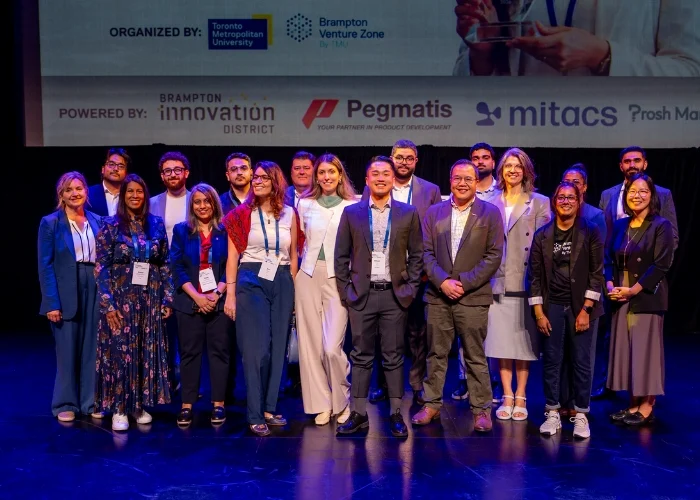
The Canadian innovation sector is brimming with ideas. The bigger challenge is translating promising technology into solutions that corporations, healthcare providers, and institutions can actually use. That challenge was essential to the Brampton Venture Expo 2026, which took place September 10 at The Rose Brampton. The sixth annual BVX, hosted by Brampton Venture Zone at Toronto Metropolitan University and powered by the Brampton Innovation District, brought founders into direct contact with investors, corporate leaders, researchers, government representatives, and ecosystem partners under the theme Where Industry Meets Innovation.
The event’s content included HealthTech, Robotics and Intelligent Systems, Artificial Intelligence, Cybersecurity, and Defence, all of which represent fields in which Canadian companies are facing increasingly complex economic and societal challenges. Main-stage discussions covered topics ranging from human-centred healthcare and AI adoption to robot deployment in Canadian industry and the potential for technology companies to penetrate the defence ecosystem.

HealthTech Takes Centre Stage
One of the defining highlights of BVX 2026 was the inaugural Mitacs Health Innovation Showcase, where five HealthTech finalists from the BVZ Launch program pitched live to investors, industry experts, and Brampton’s innovation community. In August, the competition began with ten businesses before cutting down to five finalists: Athel AI, NewGen Health, DIA Labs Canada, LOCVM, and LBX Bio. Three companies finally got a total of $80,000 in award value and support, which exceeded the previously disclosed $70,000. Alex Arrazaghi founded Athel AI, which got the Clinical Excellence Award and $35,000. The startup is building a clinical intelligence platform that uses specialized conversational AI agents to automate medical intake, gather complete patient histories, and format that data for electronic medical records.
Mussab Tauseef founded LBx Bio, which got the Pegmatis Deep Tech Award and $30,000. Its point-of-care liquid biopsy platform is being developed to make molecular cancer diagnostics more efficient, inexpensive, and accessible in clinical settings. Angélique Bernabé founded LOCVM, which got the Scale-Up Innovator Award and $15,000. The healthcare marketplace connects locum physicians with clinics looking for verified temporary medical coverage. The three winning ventures represent a significant shift in Canadian healthtech. Innovation is shifting from isolated technology to practical solutions for clinical operations, diagnostics, healthcare workforce, and system efficiency.
From Emerging Technology to Real Adoption
HealthTech was just one aspect of the discourse. BVX programming also explored how robotics and intelligent systems are being integrated into Canadian sectors, and how organizations can move artificial intelligence from testing to practical application. The event brought together professionals from Intel, MDA Space, Myant, Dynacare, Pillway, Rogers Cybersecure Catalyst, Toronto Metropolitan University, and the City of Brampton to discuss entrepreneurship and ecosystem development. This matters for Canadian SMEs because the next stage of technology adoption will not be determined only by who creates the most advanced tools. It will depend on whether solutions can solve specific business challenges, integrate with existing operations, and deliver measurable value.
Robotics and AI adoption, in particular, requires founders to understand the operational realities of the sectors they intend to serve. Bringing technology developers and potential customers together in the same space helps reduce the time between prototype, pilot, and commercial deployment.

Cybersecurity and Defence Become Growth Markets
BVX 2026 also included Cybersecurity and Defence among its core innovation sectors. The agenda included a special debate on breaking into Canada’s defence ecosystem, as well as participation from cybersecurity companies and ecosystem groups in the event’s broader startup and innovation program. These areas offer significant prospects for Canadian technology SMEs, but they also have higher barriers to entry.
Procurement constraints, security standards, regulatory expectations, protracted sales cycles, and partnerships with institutional purchasers all affect whether a new technology makes it to market. BVX events can help bridge this gap by introducing founders to not only cash, but also the industry knowledge and institutional ties required to traverse difficult markets.
An Ecosystem Designed Around Commercialization
Beyond the main stage, BVX featured startup presentations, exhibitors, investor meetings, and an Innovation Zone with partner-led workshops, fireside chats, and interactive events. Topics covered the practical issues entrepreneurs face, such as funding growth, raising capital, implementing AI, finding talent, commercializing technology, and navigating government opportunities. That structure teaches a deeper lesson about Canada’s innovation ecosystem. Startups seldom grow through finance alone.
Commercialization requires customers, talent, validation, mentorship, industry access, and networks, allowing founders to test an innovation outside the startup context. Brampton Venture Zone has helped approximately 140 firms and facilitated 108 industry pilots, with a 77 percent alumni retention rate.

Where Industry Really Meets Innovation
The lingering impression of BVX 2026 is more than just the number of startups showcased or awards given. It is critical to create conditions in which diverse sectors of the innovation economy can interact early enough to affect what is developed. Founders require access to clients and capital. Established businesses require access to emerging technology. Researchers require paths to commercialization. Governments and economic development organizations require scalable enterprises that can create long-term economic value.
By bringing those groups together around HealthTech, intelligent systems, AI, cybersecurity, and defence, BVX illustrated how an innovation ecosystem can go beyond exhibiting ideas and help put them into action. For Canadian SMEs, the shift from discovery to adoption may ultimately determine which innovations become viable Canadian enterprises and which remain promising ideas.
CanadianSME Small Business Magazine shares practical insights, business developments, and entrepreneurial stories from across Canada. Subscribe to our monthly editions for updates on Canadian businesses, and follow @canadian_sme on X for current business trends.
Disclaimer: This article is based on publicly available information and is intended for informational purposes only. CanadianSME Small Business Magazine does not endorse or guarantee any products or services mentioned. Readers should conduct independent research and due diligence before making business decisions.







Responses