

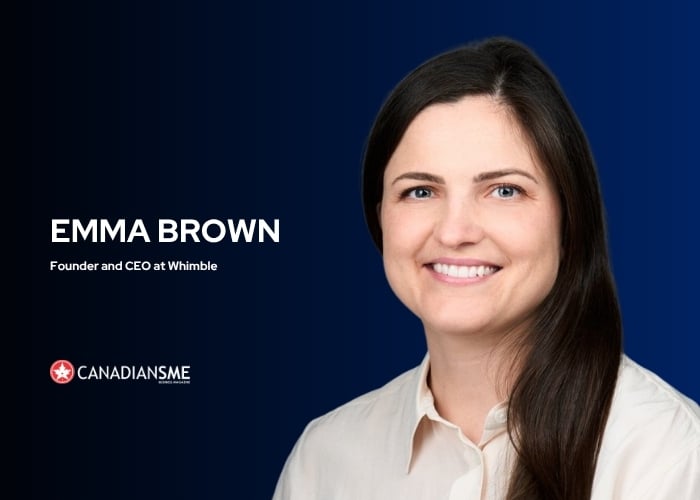
In this exclusive CanadianSME Small Business Magazine interview, Emma Brown, Founder and CEO of Whimble, shares how her personal caregiving experience and background in science and nonprofit leadership inspired a breakthrough caretech solution. Driven by empathy and a vision to make reliable, flexible support accessible for all, Emma leads Whimble in transforming home care and event accessibility—demonstrating how innovation, partnership, and lived experience can reshape the future of independent living for people with disabilities.
Emma Brown is a determined entrepreneur with a unique background in chemical engineering, science communication, and nonprofit management, and winner of the 2024 Bootstrap Awards ‘Founder of the Year’. Emma leads Whimble with a vision to reshape personal care, ensuring that quality back-up support is accessible for everyone, exactly when, where and how they need it most.
Whimble was born from both professional expertise and deeply personal experience. What inspired you to transform your own care journey into this innovative caretech platform, and how did your background in science and nonprofit management prepare you for this venture?
Whimble was inspired by my younger brother, who has a disability. I’ve seen how quickly his day can unravel when a caregiver cancels or an unexpected need arises. Those moments shaped my understanding of how fragile autonomy can be when access to care isn’t guaranteed. I wanted to change that, not just for my brother, but for everyone facing the same uncertainty.

That experience became the spark for Whimble: a caretech platform that connects people with disabilities to trusted, vetted attendants on demand. It’s built to bring flexibility, reliability, and dignity back into care, ensuring no one is left without support when and where they need it most.
While I (dramatically!) underestimated the complexity of building and scaling a two-sided marketplace in such an intimate and vulnerable space, I’ve drawn heavily on my diverse background, from engineering and business development to nonprofit leadership and stakeholder engagement. Whimble needs all of these experiences (plus a powerhouse team of people with lived experience and dedication to solving this problem) to create a more accessible future, where people with disabilities can live freely and caregivers can access meaningful work on their own terms.
Traditional home care often struggles with rigid systems and accessibility gaps. How does Whimble differ from these structures, and what do you see as the biggest misconception people have about personal/supportive care services?
In our experience, traditional home care is built for predictability: fixed schedules, standardized visits, and limited flexibility. But real life doesn’t always work that way. When a caregiver cancels or an unexpected need arises, people with disabilities are often left without options. Those gaps aren’t just inconvenient – we hear almost daily from clients who have had to miss work, school, or important life moments simply because care wasn’t available.
Whimble was created to close those gaps and complement existing systems. We connect people with disabilities to vetted, trusted attendants on demand — whether at home, at events, or while travelling. Our model centers flexibility, transparency, and client-directed care. Instead of being told when and how support will happen, clients decide what they need and when they need it.
One of the biggest misconceptions we encounter about personal care is that it must be medicalized to be legitimate. In reality, much of care is not medical, it’s human. It’s helping someone eat, travel, or participate in their community. Over-medicalizing care can add unnecessary complexity and even further limit access. At Whimble, we aim to restore balance by prioritizing dignity, independence, and safety on each client’s own terms.
Whimble’s partnerships with major events like the IIHF World Juniors and the Canadian National Exhibition showed how accessibility is not only about inclusion but also about revenue and customer experience. How do you make the case to venues and event organizers that accessibility is a business advantage, not just a social responsibility?
For any event organizer or venue looking to drive revenue, better accommodating the 25% of the population with a disability is a pretty effective way to grow your customer base! When people with disabilities can fully participate, they spend more, stay longer, and become loyal advocates. At the IIHF World Juniors, one fan upgraded to a full VIP ticket package after learning on-site care was available. At the CNE, several guests returned multiple times over the three weeks because Whimble attendants made it possible for them to enjoy exploring the grounds, catch all the concerts, and sample the food concoctions with ease.

Our partnerships show that accessibility enhances every key metric: customer satisfaction, reputation, and word-of-mouth reach. These organizations didn’t just meet compliance standards, they voluntarily elevated their entire guest experience – and won.
The shift we’re driving is simple but powerful: accessibility isn’t a “nice to have,” it’s core to customer experience. True inclusion means every guest, volunteer, or employee feels considered and welcome, and when businesses achieve that, they don’t just do the right thing; they unlock a loyal, high-value market that’s been overlooked for far too long.
You’ve described your expansion into Toronto as a test case for scaling. What are the key lessons you’re carrying from Ottawa to this new market, and how are you building a playbook that could eventually be replicated in other cities or even internationally?
Our expansion into Toronto is both a growth milestone and a stress test for scale. Ottawa proved that on-demand, client-directed care fills a real and urgent gap – but scaling that model means adapting to the unique infrastructure, demographics, and culture of each city.
One key lesson from Ottawa is the importance of trust before technology. People don’t just want fast care – they want to know who’s showing up and who’s behind the technology. That’s why our Toronto rollout has started with hyperlocal partnerships, community engagement, and a strong attendant network. We’re also applying what we learned from event collaborations like with Ottawa Bluesfest, one of Canada’s largest music festivals, and using high-visibility partnerships like with the CNE to build credibility and local demand.
Our scaling playbook blends localization with digital scalability. We want to standardize the core components of vetted caregivers, transparent pricing, and client-directed care, while working with content creators, trusted event organizers, and other partners that reflect each city’s ecosystem. Toronto is our proving ground for a replicable model that could extend across Canada and eventually internationally.
As someone who has lived and built a business around the realities of caregiving, what final advice would you share with small and medium-sized businesses that want to balance empathy, innovation, and execution in their own journeys?
I’ll be honest, balancing empathy with innovation and execution can be really challenging. Internally, the hustle culture of the startup world often pushes a “growth at all costs” mindset that clashes with building a company where people feel supported and well. Externally, decisions essential for growth – like raising prices or updating Terms and Conditions – have an immediate and very real impact on human beings who rely on and trust our platform for their care. Those trade-offs weigh heavily.

While I doubt I’ll ever find the perfect balance, I just try to be as honest as possible around the hard choices so our users know we’re human, and doing our best to solve a very complex problem. Most of the time, that honesty leads to understanding. But when it doesn’t, we’ve learned to accept that Whimble won’t meet everyone’s needs, and that’s ok.
My advice to other small and medium-sized businesses, especially in social impact, is to (more quickly than I did) understand where your solution adds value and where it doesn’t. Early on, I tried to be everything to everyone, but that only slowed our growth. Finding the balance between compassion and focus is key to building something sustainable.








Responses